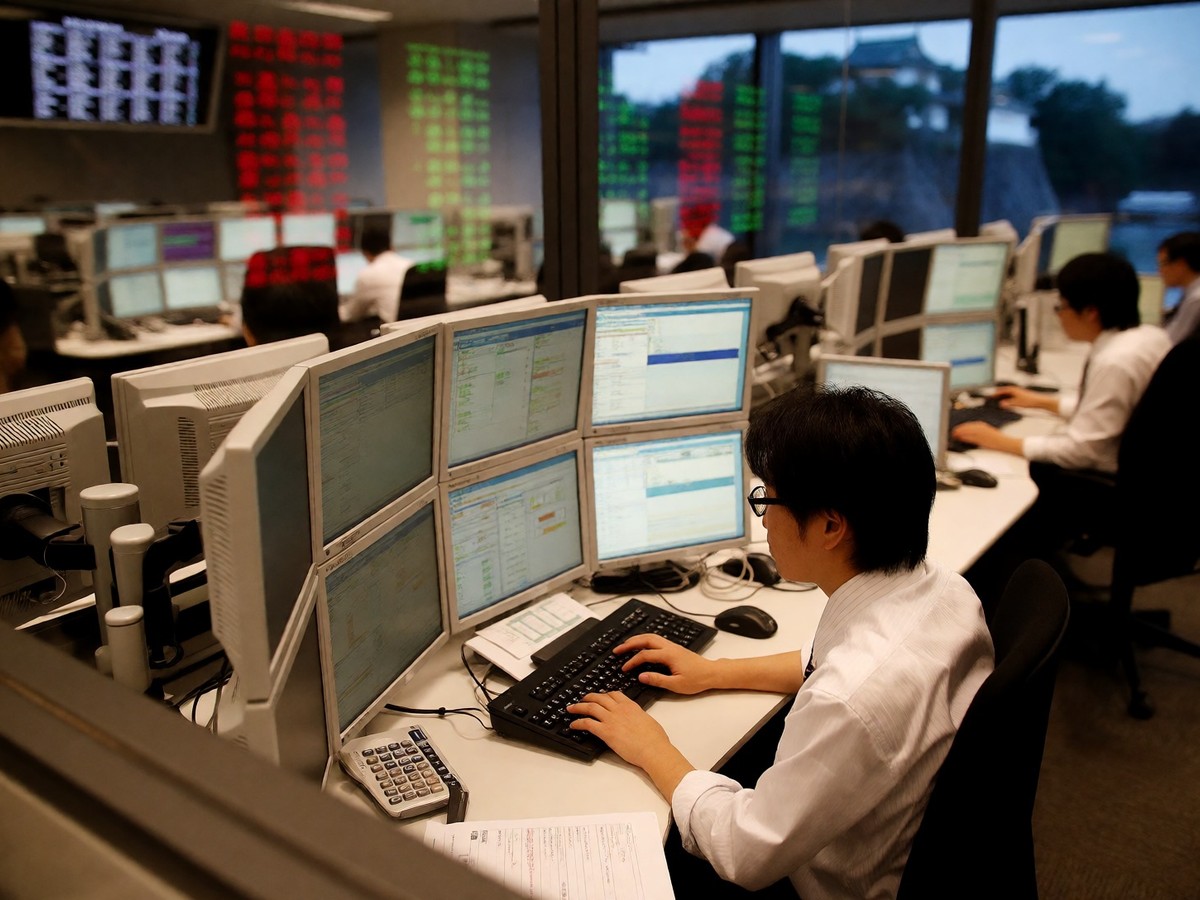
Nikkei 225 futures trade at 65,491 yen as of August 21, 2026, which sits 726 yen below the August 20 cash closing price of 66,216.79 yen. The cash index rose 890.37 yen on August 20, but the US market movement after the Tokyo close caused the futures to drop. This discrepancy between the cash index and the futures reflects the volatility in Western markets following the Tokyo session. The Nikkei 225 remains 30.10% higher year-to-date.
The yen carry trade remains a persistent threat to global equity stability.

When the Bank of Japan hiked rates in early August and announced a gradual tapering of its quantitative easing program, the trajectory of the Japanese yen changed overnight, causing Japanese investors to sell US momentum stocks to cover their unhedged holdings. These investors previously used accumulated dollars to buy US equities and bonds on an unhedged basis because the yen depreciated for years and the Bank of Japan kept policy rates low. Morgan Stanley estimates that $500 billion in outstanding yen-funded carry positions exist despite the partial unwind in August.
The August 2024 unwind remains a benchmark for current market fears. During that period, the S&P 500 dropped 6% in three days and the VIX reached 65. In August 2024, Bitcoin dropped from $62,000 to $50,000 in 48 hours as overleveraged positions faced margin calls.
The Bank of Japan and the bond market
The Bank of Japan pushed policy rates to 1% on June 16, 2026. This follows a 25 basis point hike to 0.75% on December 19, 2025. The current policy rate sits at 1% while the central bank maintains its existing quantitative tightening schedule. Japan’s inflation rate for July 2026 reached 1.90%, while the previous month recorded 1.60%.
The 10-year Japanese Government Bond yield reached 2.95% this week. This follows a rise of 4.4 basis points on August 20. In August 2026, the 10-year JGB yield reached its highest level in roughly three decades. The US-Japan 10-year yield spread stands at approximately 1.8 percentage points.
The Bank of Japan signals a conditional bias toward further tightening as long as economic activity and inflation align with its projections. Policymakers want to avoid a rapid, one-way rise in 10-year and 30-year JGB yields to prevent premature tightening of financial conditions. The Nikkei market participant survey shows over 60% of participants expect a September rate hike.
Will the Bank of Japan’s next move trigger another flash crash?
Semiconductor volatility and the Nikkei
The semiconductor sector drove the recent Nikkei volatility. Kioxia Holdings fell 10% during the Wednesday session. Advantest dropped 3.05% to 34,610 yen. Tokyo Electron fell 0.90% to 56,000 yen. Fujikura fell 8.4%. Taiyo Yuden fell 12.19%. Murata Manufacturing fell 9.17%.
The Nikkei 225 is heavily influenced by high-priced stocks. Advantest alone accounted for 42.8% of the total rise on August 13. The top five semiconductor and electronic component stocks – Advantest, Tokyo Electron, Ibiden, Murata Manufacturing, and TDK – accounted for 83.6% of the Nikkei Average rise on that day.
You already know how fast the Nikkei 225 slides when semiconductor earnings miss.
On Wednesday, August 20, the Nikkei 225 saw an intraday swing of over 2,100 points. The index dropped from a Monday high of 69,220.25 to a Wednesday low near 65,326. This represents a peak-to-trough decline of roughly 5.6%. The decline concentrated in technology names, specifically chip-and-AI shares.
The yen intervention and carry trade rebuilding
The Japanese government and the Bank of Japan intervened in the foreign exchange market on July 30 and July 31. The yen’s value surged by up to 3.3% during the July 30 session. The yen previously reached 164 per dollar before the intervention but recovered to around 157. The yen now trades at 159.425 against the US dollar.
Japanese investors use periods of yen strength to rebuild carry trade positions. Japanese investors net bought more than 5 trillion yen of foreign equities and long-term bonds over the two weeks ending August 15. This compares to a net selling of over 300 billion yen in the prior two weeks. Jesper Koll, an expert director at Monex Group, states that intervention "turbo charged" the carry trade for fundamental and long term investors.
The market targets the 155 yen per dollar level. The International Monetary Fund counts interventions conducted within three business days as a "single instance." Global hedge funds held 124,575 contracts worth approximately $9.5 billion betting on yen weakness as of July 28.
US asset exposure and Euro parity
The US dollar cannot remain too strong or too weak. Problems occurred in February 2016, March 2020, and October 2022 when the US dollar surged. Foreigners selling US assets to raise dollars create liquidity risks. If the Federal Reserve cuts interest rates, the narrowing of global interest-rate differentials could cause the US dollar to depreciate. The Fed funds rate currently sits in the 3.5% to 3.75% range. Markets price two additional cuts next year to around 3.0%.
The Euro area holds a much larger volume of US assets than Japan. Euro area nations ran persistent current account surpluses with the US for the last 15 years. Most of these surpluses went into US fixed income. If the euro appreciates, holders of US assets must either hedge their positions or sell US-dollar-denominated assets.
Japanese investors face higher costs when hedging currency risk. A Japanese investor buying a 10-year Treasury with currency hedging receives a -1.57% yield. This yield remains much lower than domestic bond yields.
Emerging market and crypto risks
The yen carry trade impacts high-yield assets like Bitcoin and emerging market currencies. Bitcoin trades at $91,000, having retreated from excursions above $100,000 earlier this year. In August, Bitcoin fell from $62,000 to $50,000 in 48 hours. The correlation between yen carry trade dynamics and crypto prices remains significant.
Emerging markets face high exposure to yen-denominated debt. Indonesia, Thailand, and Malaysia have strong trade ties to Japan. A sharp yen appreciation makes servicing yen-denominated debt more expensive. In August, emerging market portfolios attracted $45 billion. This included $41.5 billion in debt flows to Mexico and Brazil. Equity flows into emerging markets fell to $3.3 billion. Ex-China EM stocks saw $7.4 billion in outflows.
The US-Japan 10-year yield spread remains at 1.8 percentage points.
The divergence of US and Japanese rates
The US Treasury announced an increase in bond buybacks from $2 billion to $4 billion per operation on August 19. This led to a decline in US long-term interest rates and a rise in US stocks. The Tokyo market followed this trend on August 20.
The Bank of Japan interest rate remains at 1.00% as of July 2026. The US Federal Reserve maintained its policy target in July 2026. The Fed Chair noted that economic activity expands at a solid pace.
The yen carry trade creates global volatility.
| Asset Class | Data Point | Value |
|---|---|---|
| Nikkei 225 | Cash Closing (Aug 20) | 66,216.79 yen |
| Nikkei 225 | Futures (Aug 21) | 65,491.00 yen |
| USD/JPY | Current Rate | 159.425 |
| Japan 10-year JGB | Current Yield | 2.95% |
| US 10-year Yield | Current Rate | 4.641% |
| Bitcoin | Current Price | $91,000 |
| BoJ Policy Rate | Current Rate | 1.00% |
| Yen Carry Position | Outstanding Amount | $500 billion |
The Nikkei 225 remains sensitive to US tech momentum. Advantest is 34,610 yen. Tokyo Electron is 56,000 yen. Sony is 3,870 yen. Toyota Motor is 3,077 yen. Mitsubishi UFJ Financial is 3,608 yen. Sumitomo Mitsui Financial is 6,794 yen. Mizuho Financial is 26.00 yen. Advantest is 34,610 yen. Recruit Holdings is 16,970 yen. Fast Retailing is 71,540 yen. Hitachi is 5,433 yen. Apple is 313.45 yen. Microsoft is 496.37 yen. Meta is 576.14 yen. Nvidia is 209.66 yen. Tesla is 345.82 yen.
Leave a Reply