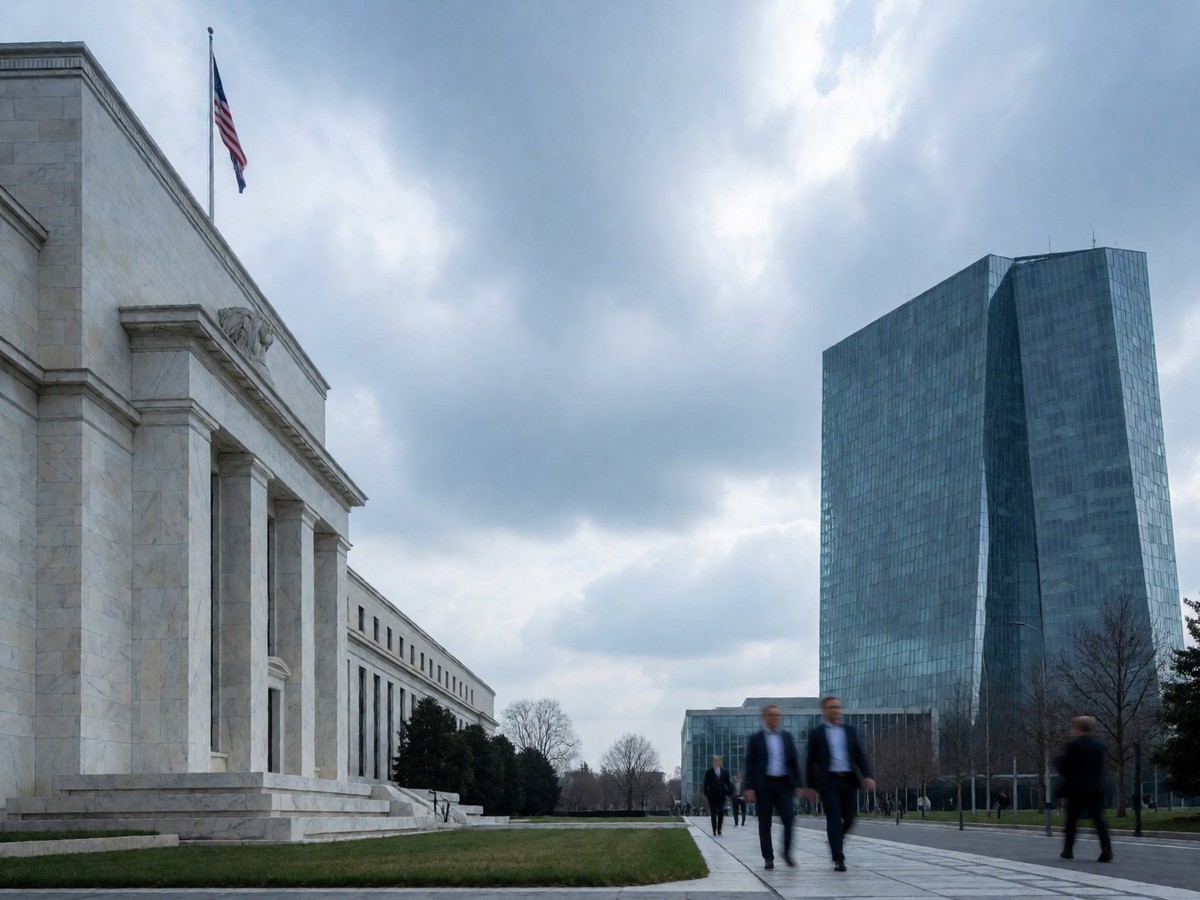
Monetary policy divergence
The Federal Reserve maintains the target federal funds rate at 3.50% to 3.75%. This decision follows the March 18, 2026, meeting where officials held rates steady. This position followed a series of rate cuts in late 2025, including a 25 basis point reduction on October 12 and another on November 12. The European Central Bank moved in a different direction. On June 17, 2026, the ECB raised its three key interest rates by 25 basis points. This hike increased the deposit facility rate to 2.25%, the main refinancing operations to 2.40%, and the marginal lending facility to 2.65%. The ECB previously began a cycle of rate hikes in July 2022.
| Central Bank | Interest Rate Type | Level (August 2026) |
|---|---|---|
| Federal Reserve | Fed Funds Target | 3.50% – 3.75% |
| ECB | Deposit Facility | 2.25% |
| ECB | Main Refinancing | 2.40% |
| ECB | Marginal Lending | 2.65% |
The Fed target stays higher.
Energy price volatility
Energy costs drive current monetary policy uncertainty. The escalation of the Middle East conflict pushed oil and gas prices higher in July. Because the renewed escalation of the conflict in the Middle East pushed oil and gas prices higher in July, headline inflation across the euro area rose to 2.9% while core inflation climbed to 2.5%. Christine Lagarde noted that the intensity and duration of this energy shock influence the likelihood of broader inflation through second-round effects.
The US economy faces different inflationary pressures. US headline inflation remains above target as May CPI reached 4.2% year over year. The Fed updated its 2026 PCE inflation forecast to a median of 3.6%. This is a significant increase from the 2.7% forecast provided in March. Core PCE inflation for 2026 also rose to 3.3% from the 2.7% projection.
Inflation stays high.
The Fed resists easing.
Economic growth and dot plots
Economic growth profiles differ between the two regions. The Fed projects US real GDP growth of 2.2% in 2026, which is a decrease from the 2.4% estimate in March. US labor markets remain resilient with 172,000 payrolls added in May, exceeding the 80,000 consensus. The unemployment rate sits at 4.3%. Annual wage growth slowed to 3.4%.
The ECB projects much weaker growth in the eurozone. Staff forecasts suggest 0.8% growth in 2026 and 1.2% in 2027. This is a downward revision from the 1.2% and 1.5% estimates in March. Defense spending provides some support, but it will not counteract growth deceleration.
The Fed dot plot indicates a hawkish outlook. Nine of the 18 participants projected the year-end 2026 target range at or below the 3.50% to 3.75% level. However, the median range sits between 3.75% and 4.00%. Three participants expect a 25 basis point hike, and five expect a 50 basis point hike. Only one official projects a 25 basis point cut.
You know the basics of central bank policy. Monetary policy transmission takes nine to 18 months to reach the real economy.
The winner
The ECB wins the rate-cut race.
The Federal Reserve will likely maintain high interest rates throughout 2026. The committee sees inflation stickiness as a major hurdle. The median projection for 2027 rates sits between 3.1% and 3.9%. Kevin Warsh, the former Morgan Stanley dealmaker who became Fed Chair in May 2026, argues that the committee must deliver price stability.
The ECB faces a different reality. The ECB staff expects headline inflation to hit 1.7% in 2026. This undershoots the 2% target. Core inflation in 2026 should average 1.9%.
ECB faces pressure.
The Fed’s inflation projections remain significantly higher than previous estimates. Will the Fed abandon its hawkish tone if AI productivity increases further?