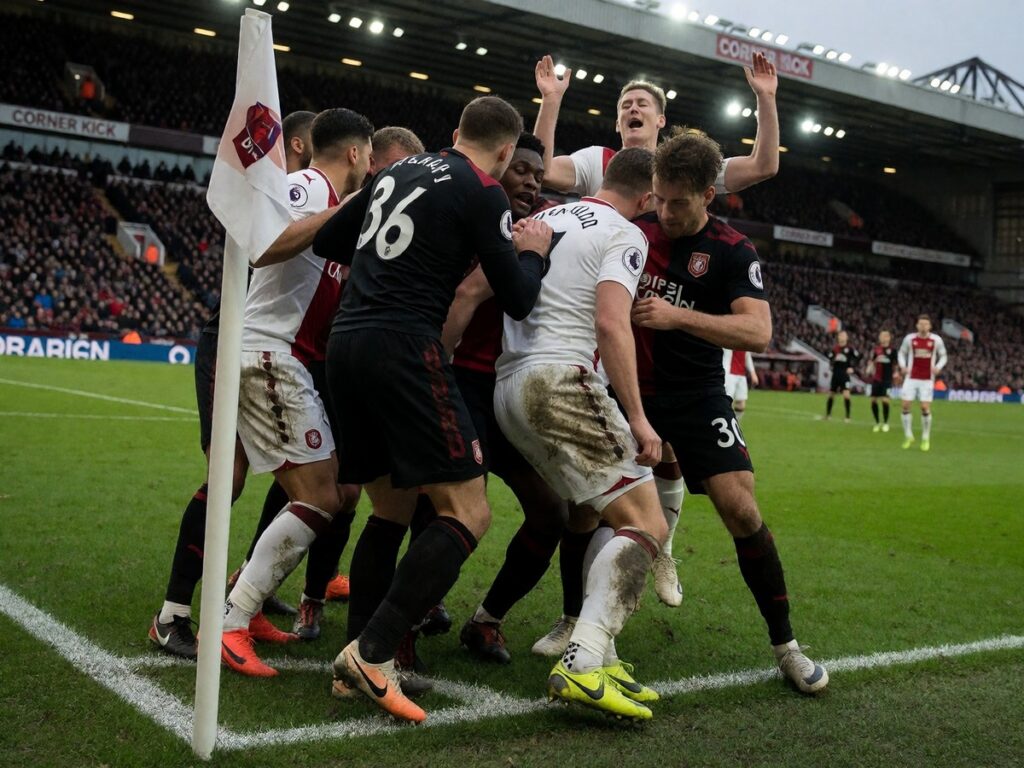
Arsenal lead the Premier League with 16 goals from corners this season. This total matches the record held by the 2023/24 Arsenal squad. Mikel Arteta uses set-pieces as a primary offensive engine. During the 2-1 win against Chelsea, all three goals resulted from corner-kicks. The team relies on targeted isolation and second-phase pressure to exploit dead-ball situations. In the Saliba opener, Arsenal used William Saliba as a vertical anchor while Gabriel provided decoy runs to create space in the six-yard box. This movement pinned Chelsea goalkeeper Robert Sanchez inside his own goal-line. The second goal came after Jurrien Timber exploited the rebound zone. He made an underlapping run to create a 2v1 overload, and his resulting shot led to a corner.
Arsenal’s high defensive line, which maintained an average distance of 44.2 meters from their own goal, allowed David Raya to act as an auxiliary center-back when sweeping up long-ball releases. This aggressive perimeter increased their defensive distance by 12% from the 2025 average. Raya earned an 8/10 rating for his ability to intercept long balls 18.5 meters outside his box. When the ball shifted to Chelsea’s right flank, the far-side fullback tucked inside to create a temporary back three. This pendulum shift neutralized Liam Rosenior’s preferred overloaded transitions. You might see how this high line forces opponents into low-value areas. Arsenal’s defensive flexibility allowed them to maintain a 4-4-2 shape when they reached the defending phase.
Tottenham’s defensive overhaul focuses on stability.
The club signed Jan Paul van Hecke for £52 million. They also brought in Marcos Senesi and Andy Robertson on a free transfer. These signings follow a season where Tottenham conceded an average of 1.5 goals per match. Roberto De Zerbi can now deploy a back five including Senesi, Van de Ven, and Van Hecke. This flexibility helps the team in games where they expect to see less of the ball. Porro signed a new deal until 2031 to secure the right-back position. The squad includes more options like Djed Spence, Destiny Udogie, and Ben Davies.
Tottenham’s interim manager Igor Tudor faced a difficult 1-4 defeat against Arsenal. Spurs used a 3-5-2 shape that shifted into a 5-3-2 defensive block. This shape relied on the midfield three to cover inside channels and funnel the ball wide. However, the physical demand caused their intensity to drop. Arsenal countered this by moving central midfielders away from the middle. This increased the pressing distance for Tottenham’s midfielders. Eberechi Eze scored his first Premier League goals since a hat-trick last November, while Viktor Gyokeres scored his ninth and tenth of the season to boost the Gunners. Arsenal’s winger Bukayo Saka also found space against Micky van de Ven when Jurrien Timber moved high.
The Premier League Big Six continue to use inswinging corners despite new IFAB rules. Pre-season data shows that 73.7% of Big Six corners were inswingers. This differs from the 51.2% of inswingers seen during the 2026 FIFA World Cup. IFAB introduced VAR interventions for attacking fouls on corners before the ball is in play. This rule change aims to reduce the "meat-wall" tactics involving pinning and grappling. International teams, including England, opted to use outswingers as a more prominent feature. In the Premier League, clubs still favour low-risk routines built around inswinging deliveries into a crowded six-yard box.
Chelsea’s defensive struggles center on set-piece transitions. The club conceded 14.05 xG from dead balls this season. This flaw was exposed during their loss to Arsenal. Arsenal’s attackers used a blocker strategy to screen Robert Sanchez’s line of sight. This forced a mistake from the goalkeeper. Liam Rosenior noted that players face significant holding and grappling during deliveries. Chelsea’s failure to defend these moments has left them on a three-game winless run. This weakness in the defensive line was highlighted by the fact that they conceded five goals in three matches against Arsenal.
Spurs struggle at home.
Under Thomas Frank, the team kept seven clean sheets in 21 matches. This was an improvement over the previous season. Frank also utilized a high percentage of long balls. Twelve percent of Tottenham’s passes travelled 35 or more yards. This approach aims to find forwards quickly. Tottenham also ranks bottom of the league for through balls attempted with just 11 in their 21 games. This lack of incisive passing makes it hard to break down low blocks.
| Statistic | Arsenal (vs Chelsea) | Chelsea (vs Arsenal) |
|---|---|---|
| xG | 1.42 | 1.68 |
| Goals | 2 | 1 |
| Corner Goals | 2 | 0 |
| Defensive Distance (m) | 44.2 | N/A |
Tottenham and Chelsea met in a penultimate game of the season. Chelsea’s interim manager Calum McFarlane switched to a 4-2-3-1 formation. Tottenham used Roberto De Zerbi’s 4-2-3-1. Chelsea’s Enzo Fernandez scored from long range. The match ended 2-1 to Chelsea. Tottenham’s defensive organization was poor enough to allow space for Pedro Neto to run into. Arsenal’s momentum in the title race rests on these small margins. They lead the league by five points. Tottenham face relegation concerns. Chelsea face a fight for fourth. Will Chelsea find a way to stop the Arsenal corner onslaught before the season ends?
Leave a Reply